The avoska: a bag with hope in its name
A net that folded into a fist and stretched to seventy kilograms. A thing named after the word "avos," meaning "maybe," because in the USSR a purchase was always a matter of luck. A small story of a great shortage.
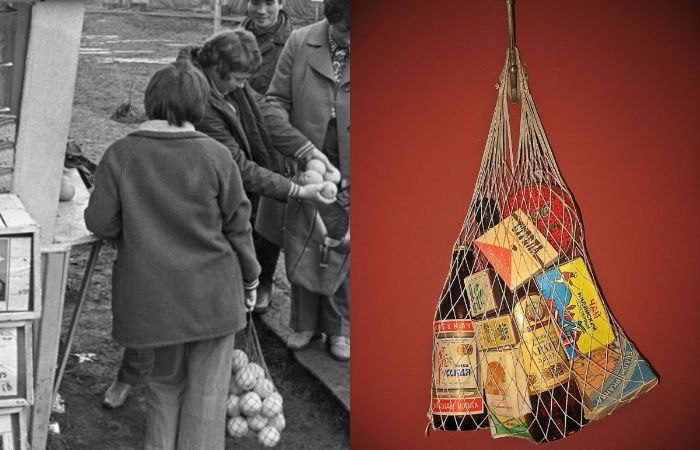
What the avoska is
The avoska is a mesh shopping bag knitted from string and resembling a basketball net. Folded, it fit in a fist, a pocket or a lady's handbag; unfolded, it turned into a capacious sack that, by Soviet standards, could hold almost anything. The classic avoska had a strict geometry: fourteen rows of twenty-four cells. It carried up to seventy kilograms and did not tear on sharp corners, which mattered in an age of glass bottles and pyramid milk cartons.
The thing's very name says more about the country than many a textbook. "Avoska" comes from the word "avos," meaning roughly "maybe I'll get lucky": the bag was carried everywhere in case something scarce was suddenly "thrown out" for sale along the way. In any other language the word would mean mere uncertainty. In the USSR it became the name of a daily necessity, and there lies the paradox: a whole nation carried folded hope in its pocket.
Where it came from
Contrary to a common belief, the net itself was not invented in the USSR. In the 1920s the Czech entrepreneur Vavrin Krcil set up production of women's hairnets; the business went badly, so he attached handles to the nets and turned them into bags. The invention spread across Europe, but it became a national symbol precisely in the Soviet Union, where it was needed most.
The name took hold in 1935, and it was given by a stage comedian. The famous Arkady Raikin brought out a character with a net in his hands and played on the word "avos": here, he said, is my avoska, maybe I will get something into it. The joke struck the exact nerve of the era and stuck to the object for good. Memoirists find "avoska" nets earlier still, in the years of the Civil War, when people carried them "in the hope of managing to get hold of at least something," but the object got its name from Raikin's monologue.
The bag of the shortage era
The avoska can be understood only through shortage. In an economy where goods did not sit on shelves but were "thrown out" suddenly and vanished at once, the mere chance to buy something was a stroke of street luck. Hence the famous reflex: see a line, join it first, ask what they are giving second. And woe to anyone who reached a counter with a delicacy and no bag: shops handed out no packaging, and there was nothing to carry a dozen oranges in.
The avoska solved this perfectly. It weighed nothing and took no space, so people carried it always, even when they were not out shopping at all. It was readiness folded into a wad: a tool of the "food hunt," as historians of daily life would later put it. The ability to stock up in bulk on the spot, when prey suddenly turned up, was not greed but a survival strategy in the economy of empty shelves. Most often the avoska carried the most ordinary things: a loaf of bread, a bottle of milk or kefir and, with luck, those oranges.
A daily life full of detail
Like every truly popular thing, the avoska grew a character and a folklore. It had an obvious drawback that became a source of jokes: the net was see-through, and everyone around could see what and how much you were carrying home, which meant it had been "thrown out" somewhere. The transparency of one's purchases was a kind of public bulletin about what was worth running for.
Over time the bag acquired conveniences and accessories. The string handles that cut into the palm under a load were replaced with flexible tubes. A special hook was sold for hanging the avoska, for instance, on a rail in public transport. Some of the nets were knitted in workshops that employed blind people, for whom it was an accessible craft. The avoska became truly universal: it was carried by the factory worker and the professor, the young and the old, because shortage respected no rank, and the bag could be pulled from anyone's pocket.
Decline and second birth
The avoska began leaving daily life in the late 1970s, when the first plastic bags appeared. The plastic bag had the same valuable trait of foldability, but it looked "imported" and modern, and for a while it pushed the old net aside. A cellophane bag with a foreign logo itself briefly became an object of chic and even of shortage, which is logical in its own way for a country where anything at all could become scarce.
And then something unexpected happened. In the 21st century, with the fashion for ecology and the rejection of plastic, the avoska returned, now as a conscious choice rather than a necessity. Mesh bags are again sewn and bought around the world as a reusable alternative to plastic, and the old Soviet object turned out to be suddenly very modern. History came full circle: a thing invented out of poverty, carrying in its name a hope for luck, became a symbol of conscious well-being. For a symbol of shortage, that may be the happiest ending possible.
Frequently asked questions
What is an avoska, in simple terms? A foldable mesh bag of string that Soviet people carried in case they managed to buy something. Folded, it fit in a pocket; unfolded, it held up to 70 kilograms.
Why is the bag called an avoska? From the word "avos," "maybe I'll get lucky." The bag was carried in the hope that something scarce would be "thrown out" for sale along the way. The name was fixed in 1935 by the stage comedian Arkady Raikin.
Who invented the avoska? The net with handles was devised in the 1920s by the Czech entrepreneur Vavrin Krcil, who repurposed hairnets. The bag became a national symbol in the USSR.
Why was the avoska so necessary? Because of shortage: shops gave out no bags, and scarce goods appeared without warning. People carried the bag constantly so as not to miss a chance to stock up if goods were suddenly "thrown out."
What was the avoska's main drawback? It was see-through: everyone could see what you were carrying. The string handles also cut the hand under a load, so they were later replaced with flexible tubes.
Are avoskas used today? Yes, the avoska returned in the 21st century as an eco-friendly reusable alternative to plastic bags, but now it is a fashionable conscious choice rather than a necessity.
Related
- Shortages in the USSR: the economy that bred the habit of always carrying a bag.
- The planned economy: why goods were "thrown out" rather than sold.
- The Soviet ruble: the money that was not enough to fill the bag.
- The dacha: where the avoska carried seedlings and the harvest.
Sources
The facts in this article can be verified against authoritative sources:
- Russiapedia (RT), "Of Russian origin: Avoska": https://russiapedia.rt.com/of-russian-origin/avoska/
- Russia Beyond, "This was the BEST Soviet accessory ever!": https://www.rbth.com/lifestyle/332682-avoska-soviet-bag
- Wikipedia, "String bag": https://en.wikipedia.org/wiki/String_bag
- Russia Beyond, "Recalling the Soviet past: Line, deficit, string bag": https://www.rbth.com/blogs/2013/10/03/recalling_the_soviet_past_line_deficit_string_bag_30493.html
- History of Retail (WPP BAV), "Avoska Shopping Bag": https://history-of-retail.wppbav.com/podcast/avoska-shopping-bag/
The exact origin of the word "avoska" has several versions; we give the most established one, tied to Arkady Raikin's monologue.